
Book Review
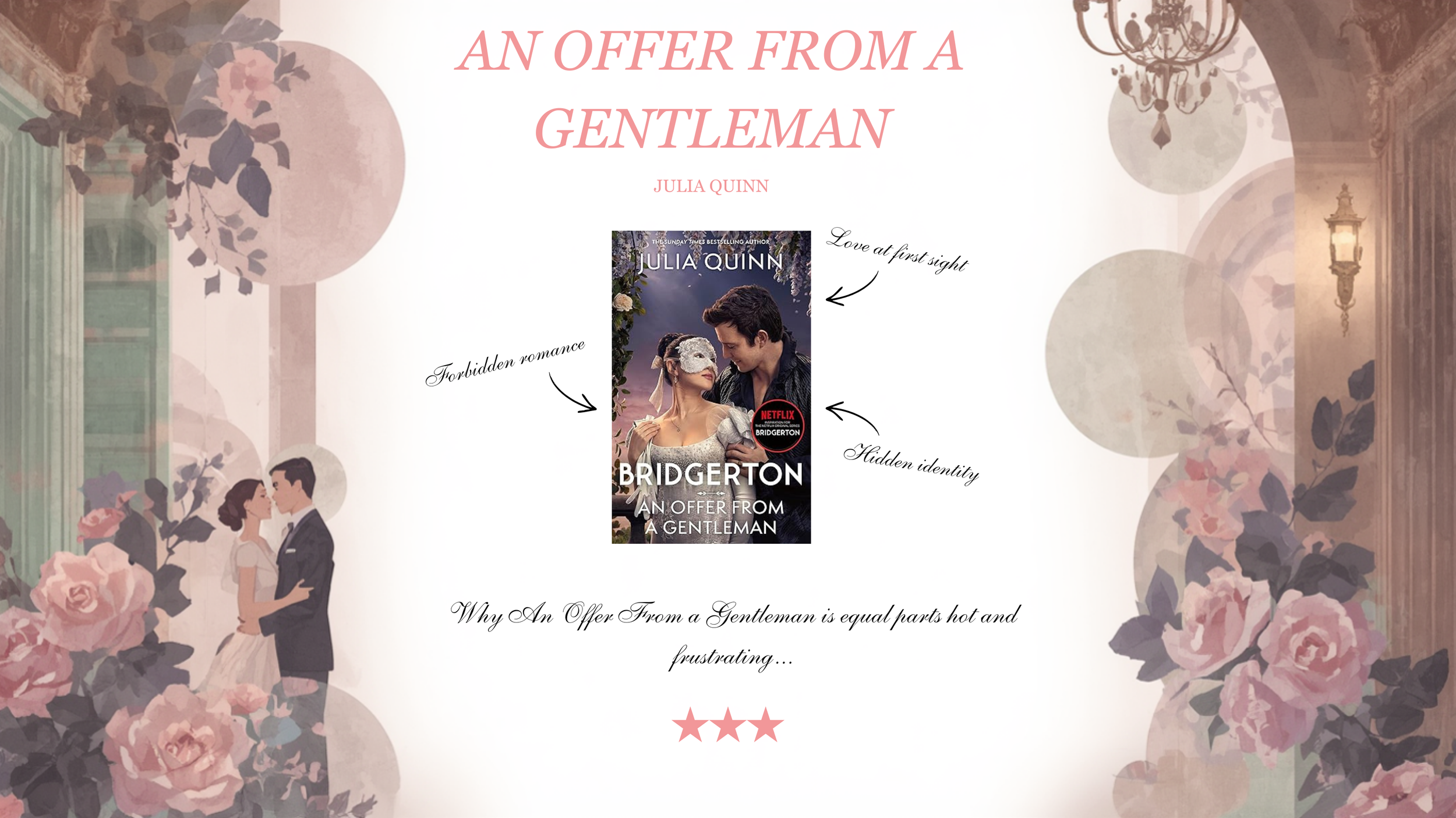
An Offer From a Gentleman by Julia Quinn
We have all no doubt seen it: season 4 of the Netflix series Bridgerton, finally featuring Luke Thompson as the irresistibly charming Benedict Bridgerton and Yerin Ha as the strong-willed (and yet effortlessly mysterious) Sophie Baek. You will have more than likely heard by now from readers of the corresponding novel, An Offer From a Gentleman, who either take issue with the canon deviations or embrace the modern updates – a bit of both in some cases – but where is the controversy stemming from?
I took the liberty of re-reading An Offer From a Gentleman in preparation for the long-awaited season 4 premiere. Crucially, what I have taken away from the experience is the simple and unavoidable fact that Julia Quinn churned out eight – yes, eight – Bridgerton books between the dicey years of 2000 and 2006, and as a result they all bear the hallmarks of an early-2000s historical romance. However, that is not to say that book 3 is without redeeming qualities — the second half proves genuinely compelling after Benedict invites (blackmails?) Sophie to stay and work at Bridgerton House, where she befriends his sisters, while the enormous elephant-in-silver in the room makes the whole situation feel increasingly implausible.
Benedict and Sophie’s romance story is written as a Cinderella retelling: the fairytale structure being something that no other Bridgerton book follows but makes for an interesting deviation from the standard formulaic approach. The start of the book is nail-biting, as the reader immediately understands that while Sophie is having this incredible night with Benedict, she must be discovered by the wicked stepmother and cast out, and this makes for some unbearable tension while you are waiting for the other shoe to drop. She finds her way back into the arms of Benedict through being rescued by him from an unsavoury interaction with her employer’s son, and from there we have the miscommunication trope laboured relentlessly until about fifty pages from the end.
As far as other tropes go, yes, he chases her but unfortunately he is written to be so persistent and unromantic in these pursuits that it really takes away from the thrill of being coveted by a handsome aristocrat. They also at one point share a bed after getting caught in the storm (when he is sick in My Cottage), but this is less only-one-bed, and more so, he-was-looking-so-tempting-lying-there-and-I-couldn’t-help-it. Not wholly unwarranted, but troublingly the only examples of forced proximity that the book offers are all caused by Benedict’s entrapment of Sophie, which is not particularly romantic. I’ve seen people describe this as enemies-to-lovers, which I would not say is accurate, and love-at-first-sight, which is accurate but which is slightly diminished by the fact that Benedict cannot identify Sophie when she is directly under his nose in his own personal bachelor pad for days on end.
In fact, all the scenes at My Cottage are tedious and don’t do much to further the romance (especially as by this time, Benedict has gotten it into his head that he wants Sophie as his mistress and has begun harassing her about it). However, this all takes a turn for the better when the pair move into Bridgerton House and we get to see more of the rest of the family – because who does not love anything Violet Bridgerton has to say? Arguably, she is the main catalyst in these two getting together, as without her Benedict would still be staring at his own paintings with his fingers crossed that he will develop any capacity for facial recognition. Due to Sophie’s repeated refusal of Benedict, it is not an understatement to say that the romance has a lot of difficulty ever getting off the ground, as there is not much chance for wooing when your love interest seems to oscillate between being clearly drawn to Benedict and retreating whenever intimacy threatens to progress as a result of her mother’s fate.
But let’s not avoid the obvious: many are gritting their teeth through the painful miscommunications and 2000s-typical sexual harassment in order to get to the more erotic sections. Admittedly, while I don’t share Quinn’s taste in heroines who were born yesterday and never even imagined what was in a man’s breeches before, she certainly has a talent for writing the kind of desperate and primal sex that will have your temperature rising while sitting on the train and subtly angling your page away from view. She sustains tension across viscerally absorbing pages, culminating in incredible imagery and searing dialogue and physical descriptions that get perfectly to the point. If you take issue with vague descriptions and fade-to-black, you will feel beyond refreshed reading what Quinn has to offer, usually occurring five times in a book. Say what you like about the rest of her writing, but I won’t hear a bad word said about her handling of the erotic. Quinn’s mastery of the erotic is, for this reader, beyond reproach.
In An Offer From a Gentleman, there is only one explicit sex scene with a couple of other instances of just getting close to it. I myself don’t mind an almost-sex scene, which can be as sexy (if not more so) than actual intercourse, and God knows this needed as much intimacy as possible in a story where the characters inherently cannot go near each other in polite society.
The book itself, divorced from its problematic elements, is not at all a bad reading experience. It gets repetitive at times, especially at My Cottage where all the characters must do is glance broodingly at each other and get snappy whenever sex is propositioned. I was able to read through chunky sections at a time, probably finishing the whole thing in three sittings which is definitely not always possible with all of Julia Quinn’s books (this is not her magnum opus, but she’s written worse). It got me through a four-hour hairdresser’s appointment, which is all anyone can ask for, even if the story is mostly more about brooding and angst than it is about passionate romance.